How We Will Deliver Our Development Priorities
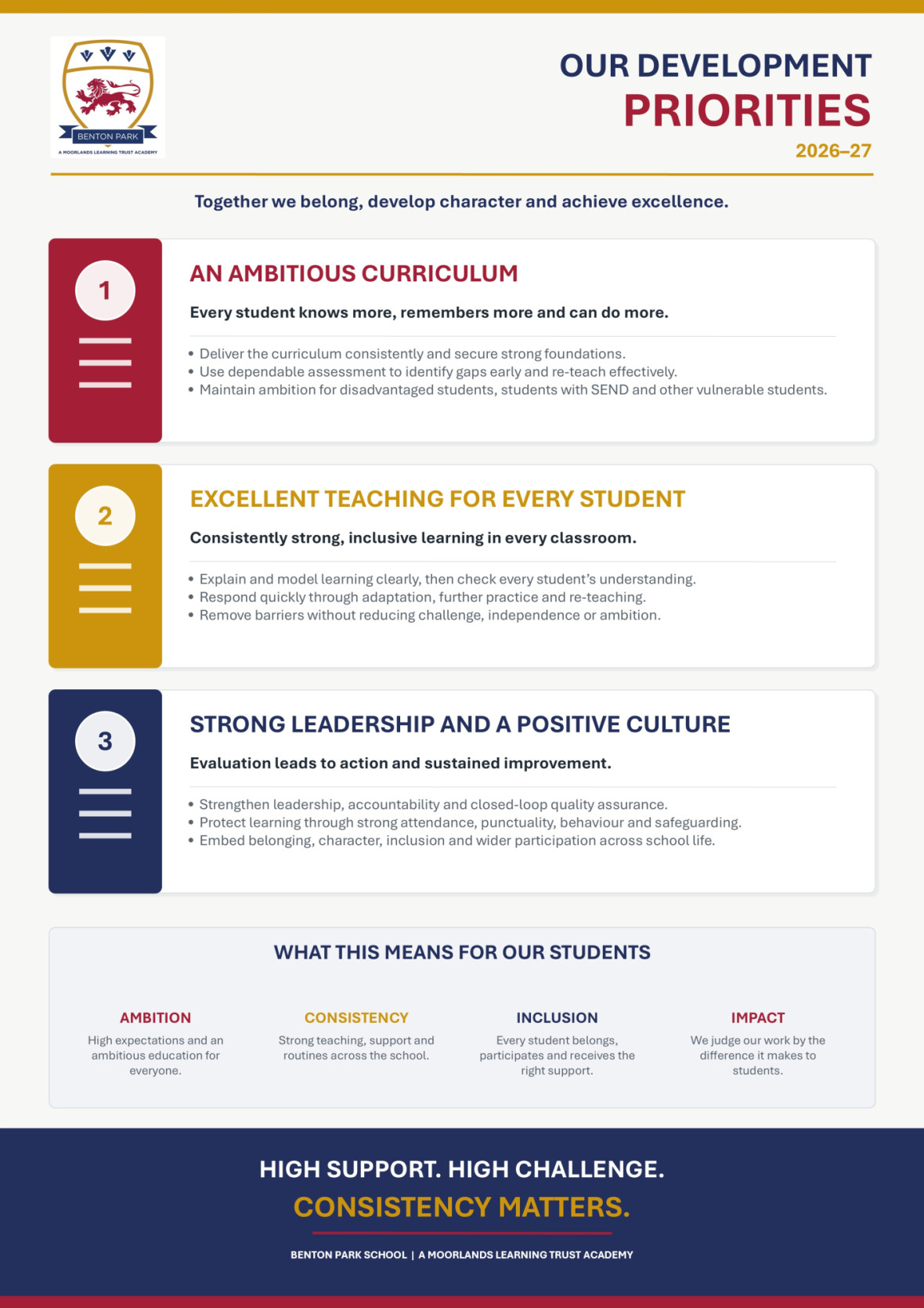
Our School Development Plan sets out the improvements that will make the greatest difference to our students.
Each whole-school priority is supported by a clear set of improvement commitments. These provide the framework for leadership, professional development, quality assurance and departmental planning across Benton Park School.
We evaluate progress through its impact on students’ learning, experiences, participation and outcomes. We do not judge improvement simply by whether actions have been completed. We check whether practice has improved, whether it is consistent and whether improvement is sustained.
Our Development Priorities
Our School Development Plan
This plan is fully aligned to the school’s self-evaluation. It focuses on the highest‑leverage actions that improve pupils’ lived experience and outcomes over time, particularly for disadvantaged pupils, pupils with SEND and other vulnerable learners. The plan prioritises: (1) consistently strong inclusive classroom practice, (2) reduced variability in curriculum implementation, teaching and assessment across subjects, (3) dependable assessment and moderation that leads to timely re‑teaching and intervention, and (4) closed‑loop quality assurance and middle leadership accountability so improvement is sustained and evidenced through impact on pupils’ learning, not completion of actions.
|
School Priority 1: Maximise impact of the curriculum for all pupils, especially the most vulnerable, by ensuring curriculum implementation is consistently strong, reading and foundations are secured, and assessment is aligned to curriculum end points so gaps are identified early and closed quickly. |
School Priority 2: Transform learning to maximise progress for all pupils, especially the most vulnerable, by embedding consistent evidence‑informed teaching, systematic checking for understanding, responsive re‑teaching and inclusive practice as the first response to need across every classroom. |
School Priority 3: Strengthen leadership, quality assurance and governance so evaluation, challenge and support secure consistently strong curriculum implementation, teaching, assessment and inclusive practice across subjects, and so improvement is sustained and evidenced through impact on pupils’ learning over time. |
|
1. Leaders ensure the curriculum is ambitious, broad and balanced and is implemented in line with leaders’ intentions so pupils—especially disadvantaged pupils and pupils with SEND—know more, remember more and can do more. |
1. Teachers present information clearly, build motivation through high expectations and clear success criteria, check understanding systematically and adapt teaching appropriately so pupils secure knowledge over time. |
1. Closed‑loop quality assurance, line management and leadership accountability are embedded across all levels. |
|
2. Subject curricula are at least as ambitious as the national curriculum, with clear end points and subject-specific rigour; decisions are refined over time through evaluation and outcomes, and reasonable adjustments ensure access without lowering expectations. |
2. Disadvantaged pupils and pupils with SEND are prioritised in planning, checking for understanding and response, with precise adjustments that remove barriers without lowering expectations. |
2. Middle leaders have the knowledge, authority and accountability to evaluate their areas accurately, develop staff and secure sustained improvement without excessive reliance on senior leaders. |
|
3. Embed evidence-based approaches that improve retention and retrieval so pupils build secure schema and long-term memory, with a specific focus on pupils who find learning hardest. |
3. High‑ratio checking for understanding leads to immediate response, re‑teaching and practice so misconceptions are corrected before pupils move on, especially for pupils who find learning hardest.
|
3. The school’s vision and values are embedded in daily routines, language and recognition so pupils and staff share a common understanding of high expectations, character and belonging. |
|
4. Assessment is embedded in everyday classroom practice and is used to check understanding, identify misconceptions early and inform timely re‑teaching and practice. KS3 assessment frameworks are aligned to curriculum end points; KS4/KS5 assessment reflects examination demands without narrowing curriculum breadth.
|
4. Teachers use modelling, purposeful scaffolding and clear explanation to develop metacognitive, self‑regulated learners, ensuring support builds independence and progression to curriculum end points.
|
4. Highly effective professional learning and leadership development are in place so staff feel confident to improve their own practice and the practice of others. Leaders reduce noise and workload, make the “why” behind decisions explicit, and recognise success so that expectations remain high, improvement is sustainable, and professional learning demonstrably improves pupils’ learning and outcomes. |
|
5. Reporting provides clear, meaningful information for pupils and parents about progress and readiness for the next stage, supporting stronger parental understanding and engagement—particularly for vulnerable pupils. |
5. Reading and other foundations (language, vocabulary and core knowledge) are strengthened across the curriculum; gaps are identified quickly and pupils are supported to keep up rather than catch up. |
5. Expectations are explicit, taught and consistently reinforced so pupils attend well, arrive on time and behave calmly and respectfully. Leaders use timely data and closed‑loop follow‑up to remove barriers early, reduce repeat concerns and reduce disproportionality for disadvantaged pupils and pupils with SEND. Attendance for the most vulnerable pupils is a priority, with personalised support and sustained multi‑agency work so these pupils access learning consistently. |
|
6. QA is fair, valid and constructive and directly improves curriculum implementation and teaching consistency; evaluation is “closed loop”, with follow-up and re-checks so leaders can evidence impact on pupils’ learning over time. |
6. Teaching activates hard thinking, maintains high challenge for all and ensures vulnerable pupils are supported to access ambitious learning and achieve well. |
6. Strengthen the school’s response to child-on-child violence and bullying. |
|
7. Personal Development is threaded through subject curricula where appropriate, building cultural capital, British values and pupils’ well‑being and safety alongside academic learning. |
7. Consistent routines and expectations support calm, purposeful classrooms, reduce lost learning time and strengthen pupils’ readiness to learn, with leaders supporting and challenging for consistency. |
7. The culture is explicitly inclusive: protected characteristics are respected, intolerance is not accepted, and pupils learn to be respectful, responsible citizens through planned personal development and wider work. |
|
8. Reading, vocabulary and disciplinary literacy are explicitly planned and implemented across subjects; reading attainment is assessed accurately and gaps are tackled quickly so pupils can access the full curriculum, with targeted support for pupils who are vulnerable. |
8. Pupils develop effective independent learning habits and study routines so learning extends beyond lessons and retention improves, including purposeful practice and retrieval. |
8. The wider offer is broad, inclusive and tracked so disadvantaged pupils and pupils with SEND participate proportionately and benefit consistently from enrichment and leadership opportunities. |